|
PROGRAM NOTES
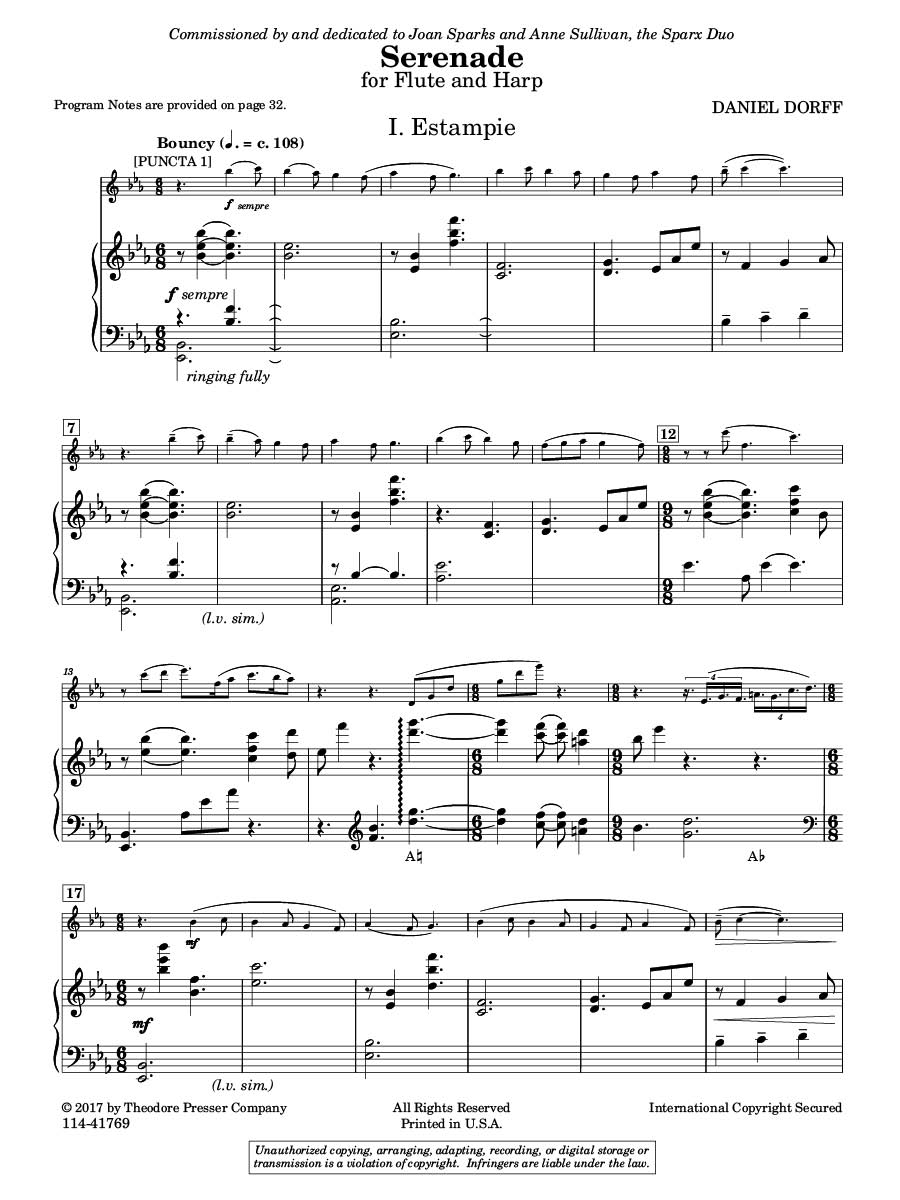
When Joan Sparks and Anne Sullivan approached me to write for the Sparx Duo, the sound world of their flute & harp duo inspired the perfect opportunity to pay homage to the late French medieval style that has long fascinated me. The resulting SERENADE is in 5 movements, the 4th being a transcription of a song by Solage, with the surrounding movements flavored and paced so the Solage movement fits naturally.
I was first exposed to French medieval music in college and have had this type of piece in mind ever since. The genre is predominantly music by Guillaume de Machaut. Based in Paris in the mid-1300's, Machaut pioneered sophisticated 3- and 4-part sacred music built as concurrent melodies over a plainchant; he also created a similar approach to love songs, continuing where the troubadours left off. The layering of simultaneous melodies often resulted in music that was strictly diatonic, yet freely dissonant within its diatonic limits. While Machaut sounds medieval, the same harmonic syntax guides much of the neo-classicism of Stravinsky and Poulenc, the rich "added-tone" chords of American popular music, and the music I was writing which was (and still is) strongly influenced by the latter.
While Machaut created a new world of 4-part free harmony and complex rhythms (newly available as music notation advanced), the next generation of Parisian composers couldn't help but outdo their teacher and maître. Known primarily from a surviving manuscript called the Chantilly Codex, many composers pushed the envelope of harmony and rhythmic intricacy in a flowering "adolescence" often referred to as Ars Subtilior, Mannerism, and the Late 14th-century Avant Garde.
One of the most beautiful love songs of this repertory is "Helas! Je voy mon cuer a fin venir" by Solage (the first manuscript at the right). Typical of medieval courtly love songs, the romantic metaphors are exaggerated, largely about dying of a broken heart, and spicy with double-entendre. The first line of the poem means "Alas! I see my heart coming to an end."
The second image shown at the right is the musically-similar "Belle bonne" by Baude Cordier, perhaps the best known image from the Chantilly Codex and typical of the mannerism of the Ars Subtilior.
* * *
The SERENADE itself blends my own language, the music of Solage, and French medieval style in general.
I. ESTAMPIE was an exuberant dance of the period, the word being cognate to our "stamp" and "stomp." It was defined not by a characteristic rhythm, but rather as a series of strains (called puncta), each played twice, often with a recurring ritornello-like closing phrase common to every strain.
II. MON COEUR means "my heart" and is similar in spirit to medieval courtly love poetry.
III. MUSETTE refers both to a medieval reed instrument, and to a folk dance using a drone bass.
IV. "HELAS! JE VOY MON CUER A FIN VENIR" is the authentic Solage song, originally composed for male singer and 3 instrumental lines labeled from the bottom up as Tenor (in the original meaning of a note that is held), Duplum (second layer), and Triplum (third layer).
V. RONDEAU is an optimistic answer to the unrequited love of Solage’s work, and a denouement of the previous movements.
REVIEWS
"Serenade was commissioned by the Sparx Duo (Joan Sparks, flute, and Anne Sullivan, harp). This harp and flute suite has five movements for a total performance time of 16 minutes. Like the aforementioned work [Big Sky], each movement can be performed alone or as part of the entire suite. Dorff wanted to honor late French medieval music and was specifically inspired by a 14th century love song by Solage.
The first movement, "Estampie," is a spirited dance with frequent meter and key changes. The second movement, "Mon Coeur," is a wistful, medieval love poem featuring some bisbigliando.
"Musette" is the third movement. It is primarily a lively dance until near the end when it takes on a more dreamy quality with some bisbigliando as it fades away.
The fourth movement, "Helas! Je voy mon cuer a fin venir," is a transcription of the actual song by Solage that was originally written for a male singer with accompaniment. It is a typical medieval love song about dying of a broken heart.
The fifth and final movement, "Rondeau, is an "optimistic answer to the unrequited love of Solage's work." An exuberant finale to the suite, it is full of enharmonics, pedal and meter changes, scale glisses, and harmonics. It is the longest movement at about five and a half minutes.
Dorff collaborated with Sullivan several times to craft the harp part so it would be very playable for the harpist. The frequent meter changes make it a challenging piece, suitable for the more advanced player, but worth the effort."
– Harp Column (Jan Jennings), November-December 2025
"I first came across Daniel Dorff via another of his serenades: Serenade for Eve, which was "after Rodin" (Fanfare 40:5). This Serenade is rather different, in that the inspiration here is a Parisian love song, "Helas! Je voy mon cuer a fin venir." As one can tell from the language, this is far from modern French; it was composed around 1370 by Solage. Dorff's piece is cast in five movements, "Estampie," "Mon Coeur," "Musette," "Helas! Je voy mon cuer a fin venir," and "Rondeau."
The music can be light (the first movement), or tender (the second), but structurally what is here is a set of variations in which the theme only gradually reveals itself. By introducing some nods toward medievalism, Dorff's music acknowledges its inspiration, while the fourth movement is a straight transcription of the song. The dialogue between ancient and modern is skillfully realized by Dorff, who is clearly a man of vivid imagination.
Clayton and Shade, perfect partners, are simply superb; their belief in this music shining through every phrase. The performance of the sound itself is beautiful, and beautifully elusive: it is as if the music floats in the air; the finale, a "Rondeau," is similarly light on its feet. All this is very well captured in sound at Sendesaal, Bremen (Germany)."
– Fanfare (Colin Clarke), March/April 2026
|
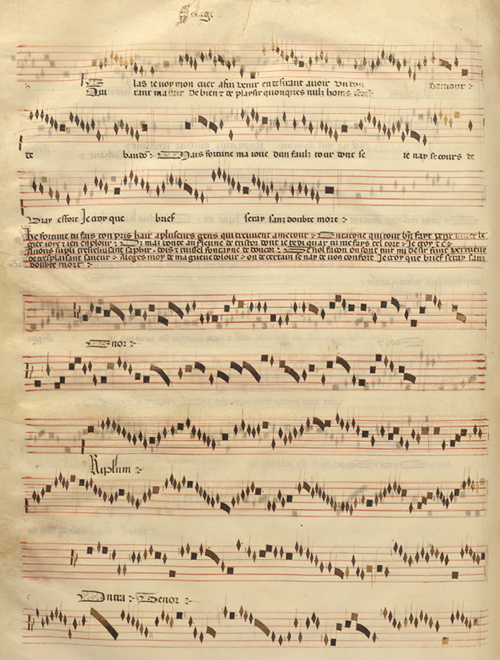
"Helas! je voy mon cuer a fin venir"
by Solage, c. 1400
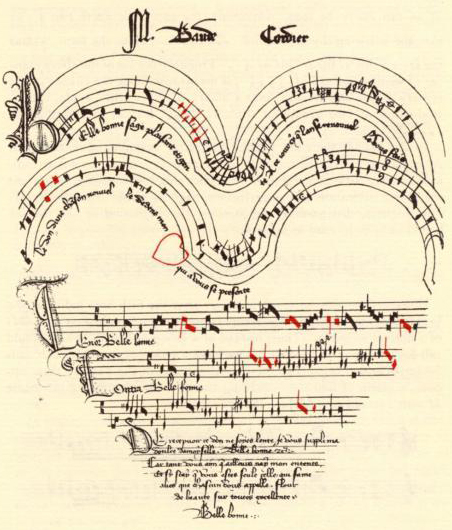
"Belle bonne "
by Baude Cordier, c. 1400
|