Music by DANIEL DORFF |
 |
| BFF's for Eb Clarinet and Bb Clarinet | |
|
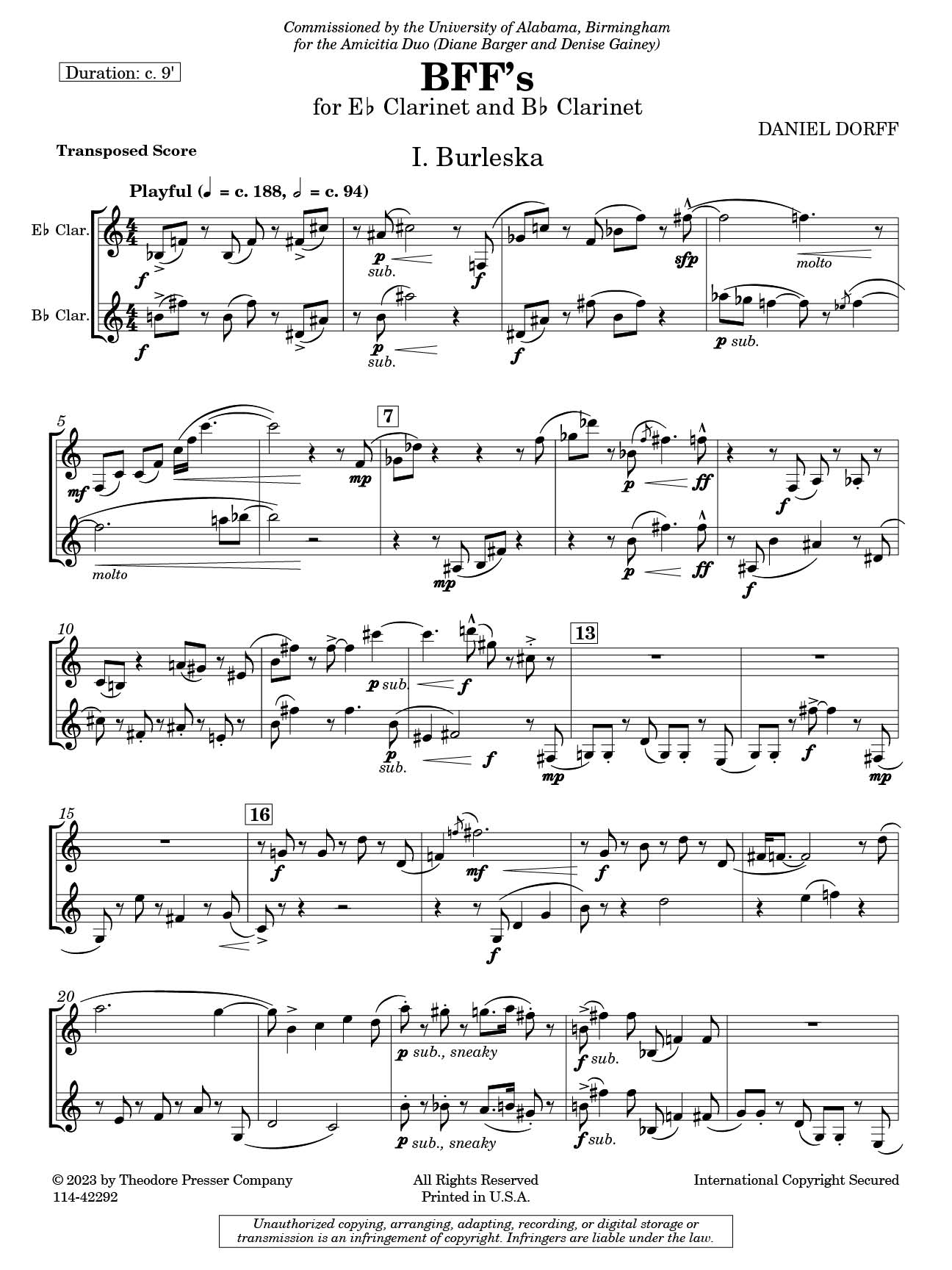
I. Burleska II. Friends III. Friday DETAILS COMMISSIONED by University of Alabama-Birmingham for the Amicitia Duo (Denise Gainey and Diane Barger). PREMIERED by the Amicitia Duo at the International Clarinet Society's ClarinetFest, June 30, 2022. HEAR & WATCH Movement I and Movement III performed by Christine MacDonnell and Christine MacDonnell. BUY from your favorite sheet music dealer, or direct from Presser. PROGRAM NOTES The giddy pleasure of writing for the Amicitia Duo (Diane Barger, Eb clarinet; Denise Gainey, Bb Clarinet) inspired this little suite's title and each movement's themes. These wonderful friends are exemplary performers, teachers, and leaders in the clarinet community; their delightfully quirky humor thrives in tandem with serious dedication to their work. Individually and as a duo, Denise and Diane are the embodiment of traits I aspire to. Amicitia is Latin for friends, and Diane and Denise are well-known among clarinetists for referring to each other as BFF's. During the unfamiliar shock of desolate quarantine in 2020, their cheeriness on social media was a refreshing oasis. While the commission (from University of Alabama-Birmingham) had been planned prior to that summer, it was in July 2020 that I turned my attention to writing this duo. I generally avoid theoretical tricks that won't be heard, and I've never been interested in the centuries-old tradition of turning alphabet letters into notes to create a theme. But while planning a piece for these BFF's, for instruments that transpose a 4th away from each other, my gears started turning. With this context, I couldn't resist embracing rather than discarding the inaudible gag. The notes seen and fingered B-F-F on an Eb Clarinet sound a perfect 4th higher than the same B-F-F on a Bb Clarinet, so this scheme could lead to fugue-like imitation, or parallel motion in 4ths or 5ths, while remaining B-F-F for each instrument. But there's more! Each of these three notes could be sharp, natural, or flat; they could jump an octave up or down; and every movement could use a different motivic design for developing the 3-note cell. Suddenly there was an expanding universe of possibilities unfolding, with each player reading B-F-F on their respective instrument. The concept was tightly organic yet flexible (like Brahms and Beethoven) rather than monotonous (like a "perfect" homework assignment). With that in mind, my mission was to write a suite sounding spontaneously composed, without conspicuous adherence to a rule. |
 |
last updated May 27, 2026 | |
 |