Music by DANIEL DORFF |
 |
| Fantasy, Scherzo, and Nocturne for Saxophone Quartet | |
|
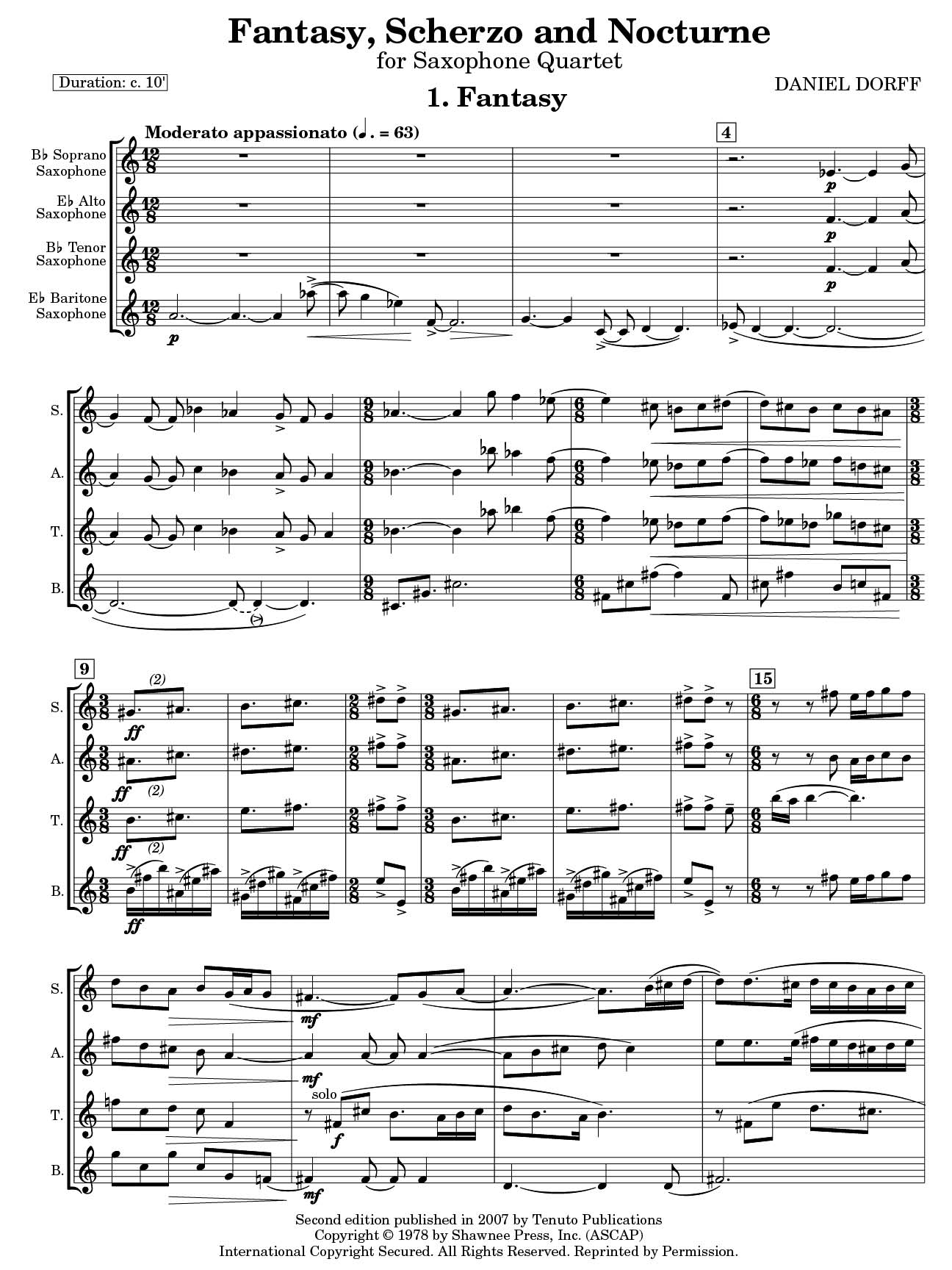
DETAILS FIRST PRIZE, Aspen Music Festival Composers' Competition, 1974. RECORDED on Orange Note (Scherzo only) by the Harmo Saxophone Quartet (Japan). BUY from your favorite sheet music dealer, or direct from Presser. PROGRAM NOTES (coming soon) REVIEWS "One hopes that many college ensembles will add this interesting selection to the short list of American saxophone quartets." – MLA Notes (Steve Mauk), September 1979. "The Fantasy is a lovely lyrical movement in medium tempo, followed by the fast, playful Scherzo. The slow Nocturne begins with a lovely duo for tenor and baritone saxophones. This is a dramatic and emotional movement... It's a good piece for both college students and professional players. The ensemble writing is excellent, with all four voices getting a chance to sing out. It is a remarkable work from such a young composer. – Saxophone Journal (Susan Fancher), September/October 2007 "Fantasy, Scherzo and Nocturne is a three-movement piece approximately 10 minutes in duration. It is modern sounding but not to the degree that you cannot understand it while listening, as it is melodic most of the time. Upon hearing the first movement, "Fantasy," the listener will immediately notice the metric freedom of the opening melodic statement. This emotive improvisatory technique continues in subsequent melodies in the first and third movement and is briefly punctuated by areas with a strong rhythm pulse. Harmonically it is supported by quintal harmonies (stacked fifths), which create open and dissonant sonorities. The "Scherzo" contrasts the outside movements because of its overall "playful" character and strong rhythmic pulse outlining an arpeggiated quintal harmony. Like the first movement, it uses a triple subdivision of the beat and often creates tension by pitting duple against the prevailing triple metric beat. In addition to this technique, the "Scherzo" has unexpected metric changes to 5/16, 6/16 and 7/16. The metric variations are musically very effective as they abruptly change the listener's rhythmic expectations. The final movement, "Nocturne," is less metrically challenging and relies on subtle tone and timbral changes in an impressionistic fashion to create a wonderful "misterioso" effect. It uses a two-measure melodic pattern from which a motivic fragment is often repeated among the instruments. Fantasy, Scherzo and Nocturne is appropriate for an advanced high school or young college saxophone quartet as an introductory piece to less traditional styles of music. It is challenging enough that this age group will need a coach to aid the ensemble through the metric changes and the subtle rhythmic pulse present in the outer movements. Technically the piece is not too difficult, but the soprano and baritone parts require the performers to play in the low range of the instrument piano and briefly progress through conjunct lines in the palm keys. – COPYRIGHT 2008 Music Teachers National Association, Inc.; reviewed by Brian L. Trittin, Concordia University |
 |
last updated May 25, 2026 |
 |