Music by DANIEL DORFF |
 |
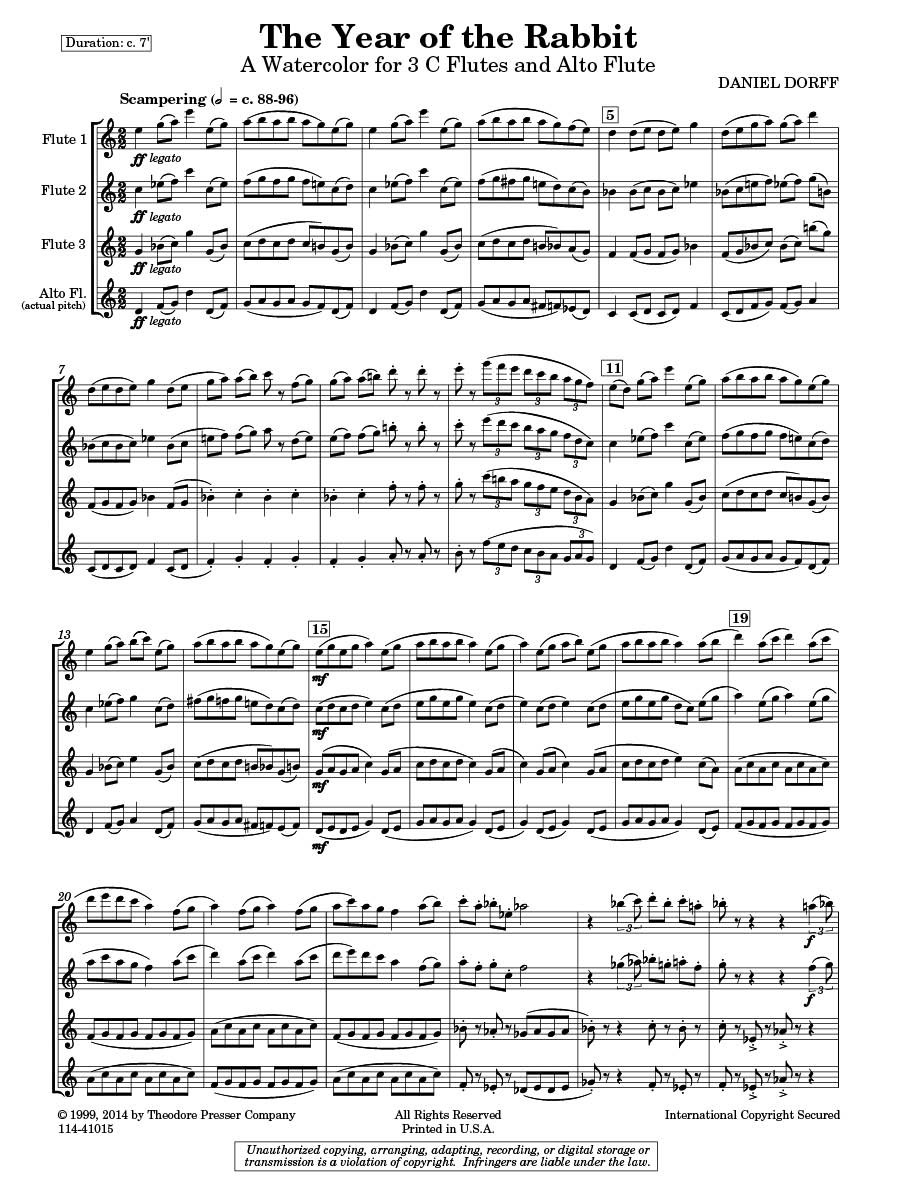
| The Year of the Rabbit A Watercolor for 3 C Flutes and Alto Flute (quartet or ensemble) | |
|
Duration: c. 7'
DETAILS PROGRAM NOTES In 1997 I had the fascinating experience of visiting the Taiwan Palace Museum, which holds the majority of art collected from both Taiwan and mainland China from the past several thousand years. This six-story building rotates its display every three months, and the collection is so large that it takes 30 years to show everything. Seeing those works displayed in June 1997, I was most taken by the many carvings dedicated to the Asian Zodiac cycle. Many artists in various media and styles have depicted the twelve-year animal cycle as a set of stylized carvings or drawings, and I've been eager to create a musical parallel ever since this visit. In late January 1999, flutist-composer Alexandra Molnar-Suhajda asked if I had any new flute choir music that her ensemble could premiere at the Mid-Atlantic Flute Fair in February. I didn't, but it struck me that a flute choir would be good to portray the "year of the rabbit," which was coincidentally beginning that weekend.Within a few days the piece was started and finished. The music, in various ways, pays homage to the many "Rabbits" in my immediate family, to rabbits in general, and to the Chinese astrological sayings about people born in the year of the rabbit.
THE
YEAR OF THE RABBIT is dedicated to Alexandra Molnar-Suhajda, who (I later
discovered) was also born in the Year of the Rabbit. REVIEWS "This second edition comes fifteen years after the original and features larger parts, better spacing, clearer cues, simplified cautionary accidentals, and a few minor musical changes. The work can be played by flute quartet or by an ensemble, though the solo quartet more fully captures the "watercolor" of the title." – Flute Talk (Diane Boyd-Schultz), February 2015 "Daniel Dorff always pleases, and his THE YEAR OF THE RABBIT (1999), evidently following a personal Chinese calendar taste, did not disappoint. Dorff is deeply musical, eschews rhetoric, and this piece for eight flutes was charming and unaffected. – Penn Sounds (Lou Camp), Summer 1999
|
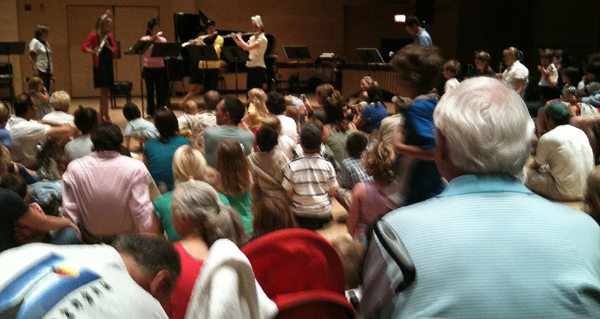
2010 performance at Aspen Music Festival all-Dorff children's concert 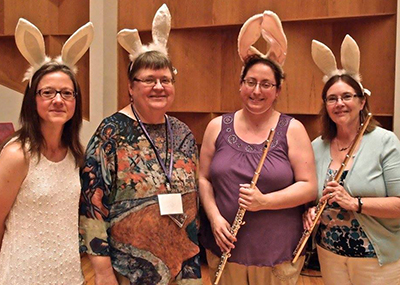
The Pocono Flute Quartet doing it in style |
last updated June 20, 2026 home | |
 |